Reffin' Ain't Easy
A local FIFA referee shares his journey
By Zak Koeske
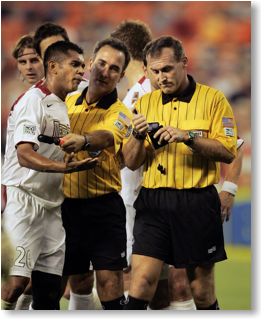
Professional sports officials have certainly taken a lot of heat lately -- what with umpire Jim Joyce's blown call that cost Tigers pitcher Armando Galarraga a perfect game and referee Koman Coulibaly's inexplicable goal reversal that snatched a likely victory from the United States in the World Cup.
It's unusual to watch a game at any level without some bystander whining about the officiating. Officials inevitably get a bad rap because we expect them, as controllers of the game, to be perfect.
Political commentator George Will once said of baseball umpires, "They are supposed to be dispassionate dispensers of Pure Justice, icy islands of emotionless calculation." Or in other words, machines.
But officials aren't machines. They are human beings and they make mistakes.
Still, who hasn't seen an official make repeated baffling calls and wondered, 'Where did they get this guy?' – the implication being that he was simply pulled off the street and could be replaced by Joe Sixpack.
Much to the disgruntled fan's chagrin, however, a professional official's job can't be performed by just anyone.
The road to officiating at the highest level is a long, strenuous and ultimately thankless process. One that Grove City's C.J. Morgante knows all about.
Morgante, 36, spent 20 years officiating before finally getting his FIFA badge in 2007 – becoming the first male soccer referee from Western Pa. to earn the distinction.
"I could probably live my life over and not be in the position that I'm in," said Morgante, who never set out to become a FIFA referee. "It's a lot of politics, a lot of right place right time, right people pushing me, right geographic location. The stars really had to align for me to be in this position."
Morgante began blowing the whistle at age 13 with nothing more than the thought of earning some supplemental income on his mind. He continued officiating while attending McGuffey High School and later Allegheny College, moving up slowly but steadily through the ranks until he was qualified to become a state referee. At the state level, referees are qualified to officiate top-level amateur and professional games, like those of the Pittsburgh Riverhounds.
After five years, numerous fitness tests and countless assessments at the state level, Morgante received his national badge which enabled him to run lines in the MLS, the nation's highest professional league.
Soon after, he was asked to make an important career decision – whether to focus on being a referee or an assistant referee.
Referees are paid significantly more per match and have full authority on the field to call fouls, card players and start and stop the action at the blow of their whistle. Assistant referees, also known as linesmen, stand on either sideline during a match and are responsible for calling offside penalties and determining when the ball has gone out of play.
"The referees are like the lead singer in the band," Morgante said. "The lead singer gets all the fame and the glory, but the band doesn't go on without the two guitarists. Assistant referees are essential to the game just like the two guitarists are essential to the band."
Morgante chose to pursue the assistant referee path, because he said it fit his personality and was where he felt he could best serve the game at the highest level.
"I'm more of a black and white person," he said. "As an assistant referee you're either right or you're wrong. There's not a lot of gray area. Whereas with a referee, there's a lot of judgment -- it's more so controlling the match."
After spending three years as a national referee, a spot opened up on FIFA's international panel of referees for which Morgante was then nominated. In accepting the appointment, he became one of only 10 assistant referees in the country serving on the panel and eligible to run lines on international competitions, like the World Cup.
Since becoming a FIFA referee three years ago, Morgante has done five World Cup qualifiers and traveled to Nigeria in October for the U17 World Cup. In November, he ran lines on his first MLS Cup final, a dramatic showdown at Seattle's Qwest Field which ended in a penalty shootout.
But Morgante said the most exciting game he's done was a friendly between Brazil and Mexico in Foxborough, Mass., during his first year on the international panel.
"They put 68,000 people, standing room only in Gillette Stadium – the largest crowd they ever had up there, including football games," he said. "Walking through the tunnel, you could have shut the lights off and we'd have still been seen walking out to the field because there were so many camera flashes."
Morgante said he is extremely thankful that officiating has afforded him the ability to travel the country and the world – even if he hasn't always been treated kindly by fans in other countries.
"When I'm in Central America, you're running a line with 45 or 50 thousand people and you make a call that they're not happy about, whether you're right or wrong ,they're going to be throwing pee bags, water bottles, beer," said Morgante, who was once hit with a road flare while officiating a game. "I don't care how tough of a guy you are, that's going to make the hair on your back stand up."
In his opinion, the palpable excitement at international soccer games has no parallel in American sports.
"There are smoke bombs and road flares and flags on fire," said Morgante of games in Central American countries, where referees are escorted to and from games by heavily armed military police. "The atmosphere is very, very intense. I 'm a diehard Steelers fan and Steelers fans are passionate about the Steelers, but it's no comparison to what soccer's like in some of these other countries."
Morgante and the three other members of his officiating crew were on a shortlist of 38 crews in the running for 30 spots at this year's World Cup in South Africa. Of the five North, Central American and Caribbean (CONCACAF )crews on the list, three were given World Cup spots and a fourth crew was selected as a reserve. Morgante's crew, despite strong showing at preliminary fitness assessments, was left off.
"We were hoping to be on that list, but we are a very young crew, somewhat of a new crew on the world scene," he said. "We didn't have the seniority that we needed and on top of that we had a few minor bumps in the road. The last two years our performances weren't as squeaky clean as I think we needed to be at the World Cup."
The good news for Morgante's crew is that two of the CONCACAF crews that were sent to South Africa will be retiring by 2014 – FIFA mandates that all referees must give up the whistle by age 45 – so a shot at the next world Cup is a real possibility.
"Seniority wise and experience wise we'll have four more years under our belt. If our performances stay strong, hopefully we'll be at the 2014 World Cup in Brazil."