Dethroned
Numerous issues keep Pens from defending Cup
By Bob Grove
For the first time in three seasons, the Penguins are watching the Stanley Cup Final on television – if they're watching much at all, painful as that viewing probably is in light of their unexpected Eastern Conference Semifinal round loss to Montreal.
Pittsburgh began the 2010 Stanley Cup playoffs facing two challenges: becoming the first team in 12 years to repeat as Cup champion, a feat that won't get easier in the salary cap era; and finding a way to get past likely second-round opponents Washington or New Jersey, teams the Penguins faced 10 times during the regular season without earning a single victory.
But then the unthinkable happened. While the Penguins dismissed Ottawa in six games in the opening round, the Presidents Trophy-winning Capitals were shocked by the eighth-seeded Canadiens, losing three of four games on home ice, where they had been nearly unbeatable. And the Devils went out meekly in five games to Philadelphia, a team that needed a shootout victory on the final night of the regular season just to qualify for the playoffs.
It appeared the table was set for another run to the Final, but that was before the 2010 Eastern Conference playoffs went from merely surprising to off-the-charts crazy. Boston got Marc Savard back from a concussion and bolted to a 3-0 lead against Philadelphia in the second round, then became the third team in NHL history to cough up that series lead, losing to a Flyers team playing without Jeff Carter and Ian Laperriere. And the defending champs couldn't solve Jaroslav Halak, couldn't stop Mike Cammalleri and delivered their worst playoff performance of the spring in Game 7 on home ice as the team's Mellon Arena era ended not with a bang but with a crash.
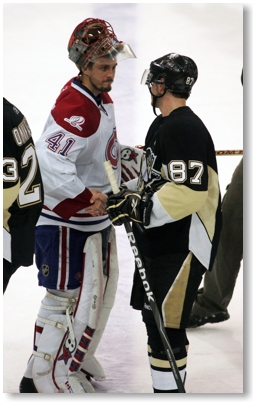
The Canadiens, it turned out, were much better at playing their game than the Penguins were at playing theirs. Coach Dan Bylsma's mantra is to have his team play an up-tempo game, force the play and deliver a physical forechecking game that wears teams down over the course of a series. But it didn't happen, even against a Montreal defense that was depleted by significant injuries to Andrei Markov and Jaroslav Spacek. The Penguins' ability to get into that forechecking game was limited by poor puck management, both emerging from their own zone and coming through the neutral zone, and when Pittsburgh did get time in the Canadiens' end, it didn't translate into goals.
The work of former Penguin Hal Gill and his defense partner Josh Georges was certainly a factor, as was the superb goaltending of Halak. But there were numerous other factors that pushed Pittsburgh out earlier than planned.
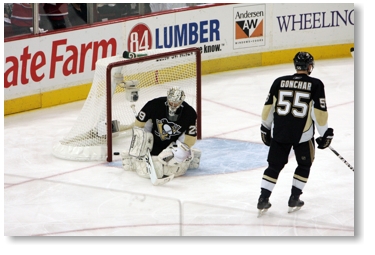
The Penguins of 2009-10 were not as good at protecting leads as they have been in past seasons, and that came back to haunt them in the Montreal series, especially in Games 4 and 6 at the Bell Centre. The Penguins never made life difficult for Cammalleri, who almost single-handedly supported a Montreal attack that, as the third round showed, was not exactly overpowering. The penalty killing was poor, especially on home ice, where the Penguins lost four of the seven games they played this spring, and the goaltending of Marc-Andre Fleury wasn't nearly good enough. In the 2010 playoffs, Fleury three times allowed a goal in the opening 90 seconds and six times allowed a goal in the opening five and a half minutes, and he continues to be plagued by soft goals.
But most confounding for the Penguins was the production of Sidney Crosby and Evgeni Malkin, who each had a single goal in the Montreal series – a recipe for disaster when their wingers aren't scoring, either. How much fatigue played a role in their performances is always up for debate, especially when the team has played 303 games over the last three seasons and both played in the Olympics this winter as well.
But Crosby was coming off an incredible first-round performance, was the focal point of the Montreal defensive game plan and found other ways to contribute. Malkin's playoff performance was more troubling, especially coming on the heels of a regular-season that was average in most ways. Malkin seemed almost distracted at times, particularly in Game 7, and then at other junctures in the playoffs was trying to do it all himself. The fourth-year center scored one goal at even strength this spring and still appears to struggle with his confidence when things don't go well.
But any fair evaluation of Malkin must include a wider discussion of his linemates. For much of the regular season, they were Ruslan Fedotenko and either Pascal Dupuis or Max Talbot. Fedotenko had arguably his worst NHL season and watched the end of the Montreal series from the press box, while Talbot endured an injury-plagued winter that limited his contributions.
Pittsburgh's lack of scoring punch from the wings, addressed in part by the acquisition of Marian Hossa in 2008 and Chris Kunitz and Bill Guerin in 2009, was more pronounced this spring as deadline pickup Alexei Ponikarovsky continued his playoff struggles. Only two of Pittsburgh's top seven playoff goal-scorers were top-six wingers, and both (Kunitz and Guerin) played with Crosby.
Where to go from here?
GM Ray Shero has eight regulars and Ben Lovejoy—almost certain to earn a regular spot on defense next season—hitting unrestricted free agency July 1: Guerin, Fedotenko, Ponikarovsky, Mark Eaton, Matt Cooke, Jay McKee, Jordan Leopold and Sergei Gonchar. Nick Johnson and Chris Conner, who played sparingly in the NHL this season, are restricted free agents, and five regulars are entering the final years of their existing contracts: Dupuis, Talbot, Mike Rupp, Craig Adams and Eric Godard.
Gonchar's failure to reach terms of an extension during the season doesn't bode well for his return next season, and that will have obvious implications for the power play. The presence of Kris Letang and Alex Goligoski, however, will help soften the blow if Gonchar leaves. Eaton has been a good value for the Penguins, and Jordan Leopold was an excellent fit with Pittsburgh after arriving at the trade deadline.
Guerin, who would turn 40 next season, is likely considering retirement. Cooke is coming off his finest season with the Penguins and is deserving of a raise from his $1.2 million contract – a raise that could be offered without breaking the bank as long as the deal's length is not objectionable.
In addition to Lovejoy, center Mark Letestu seems ready to play every night in the NHL and has the potential to become one of the team's best faceoff men should he earn a spot on the fourth line. Winger Eric Tangradi is coming off his first full pro season, scoring 17 goals and 39 points in 65 games for the Baby Penguins, but might not quite be ready for the NHL. Wilkes-Barre/Scranton's leading scorer, center Dustin Jeffrey, can play the wing but doesn't fit cleanly into the Penguins' depth chart.